
European manufacturer of specialist fasteners · Industry expertise since 1971
Specialist fasteners for pressure equipment
We select and manufacture PED-compliant fasteners - bolting for flanged joints and non-standard, drawing-based parts matched to your project requirements and operating conditions, with full material conformity and documentation.

If you are responsible for material selection, inspection documentation, or the execution risk of a pressure system - you are in the right place.

Fasteners for the oil & gas, chemical and power industries
We supply fasteners that determine the tightness, durability and safety of joints. Our products work in critical infrastructure that cannot be allowed to fail - under pressure, at high temperature and under technical inspection. Pressure equipment subject to inspection requires components with confirmed material origin; every batch ships with a complete set of inspection documentation.
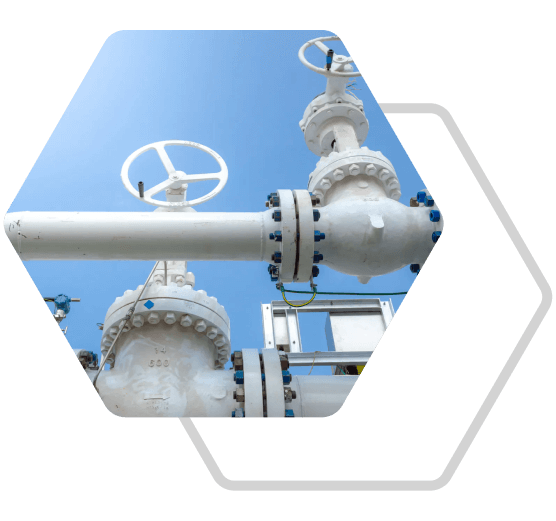

Pipeline systems
Fasteners for pipes and flanged joints - for gas, oil and process media.

Pressure equipment
Pressure vessel fasteners for vessels, power boilers and heat exchangers.

Metering & reduction stations
Nodes requiring precise joints and tightness.

Equipment & transmission mountings
Anchors for tanks, turbines, units, pumps and power masts.
Effect: Tightness and durability proven in practice - not only in the specification.
We reduce critical inspection and acceptance risks
The specification is only the beginning. We do not let a small fastener become the system's most expensive problem. Already at the inquiry stage we catch the non-obvious risks: wrong material for the medium, an over-specified class, missing documentation, or the need for drawing-based parts.
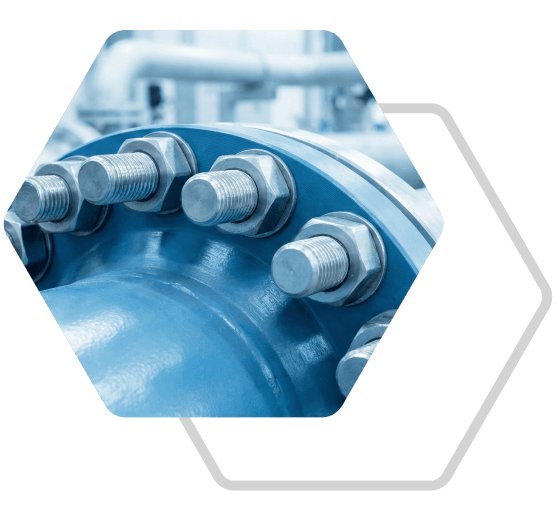

We verify material selection
We verify whether the specified material grade and property class are suitable for the medium, pressure, temperature and project requirements.

We manufacture non-standard parts
Where the standard does not fit, we make parts to drawing - for non-standard connections and assemblies.

We prevent site returns
We check conformity with inspection requirements before dispatch, so acceptance of the pressure equipment is not held up by a missing document or an incorrect material class.

We keep documentation consistent
We provide certificates and inspection documents (PED, 3.1, mill certificates) matching the requirements stated in the project.
Effect: On-time closure of the work stage - with no going back to material selection.

What we do differently
We deliver a technical solution, not just goods. As a manufacturer we have full control over the process - from material selection to finished product. We eliminate the risks that can hold up technical acceptance.
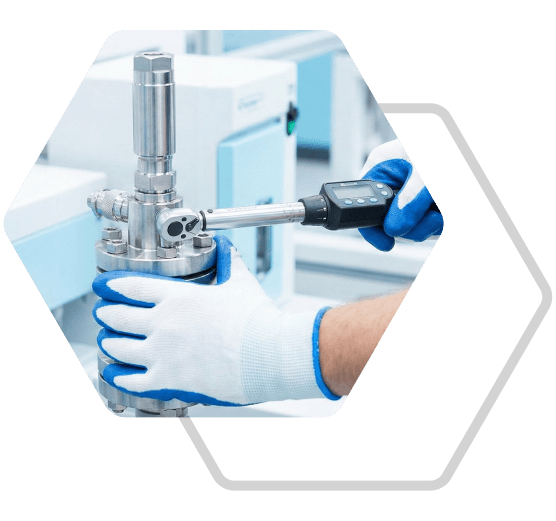

Technological verification
We analyse the operating parameters (pressure, temperature, medium). If we see a technological risk, we present a material recommendation that ensures safe operation.

In-house machining
We produce parts in non-standard dimensions, from special materials, and drawing-based details requiring precise machining.

Assembly-ready kitting
We streamline site logistics. We supply complete, certified joint components: bolts + nuts + washers.

We keep it consistent
We treat documentation as an integral part of the product - certificates correspond exactly to the batch that arrives on site.
Effect: Certainty that what was designed is exactly what is installed and invoiced.
PED-compliant material solutions
We use only materials with confirmed chemical composition and mechanical properties, eliminating the risk of failure.
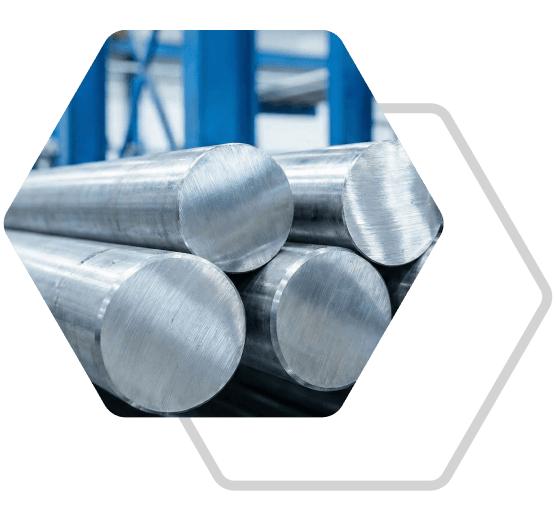

Special steels
We manufacture fasteners for high-pressure applications from certified materials. For carbon- and alloy-steel pressure systems we use grades 25CrMo4, 42CrMo4, 21CrMoV5-7, C35 and C45. Austenitic-steel systems are served with components in grades A2 and A4, resistant to aggressive media.

Standard and non-standard
From classic bolts and nuts - DIN 2510, DIN 2510-5 and ISO 4014, 4017 and 4032 - to DIN 976 threaded rods in special steels, cut to length for specific flanges.

Protective coatings
We supply fasteners with hot-dip galvanized, electroplated and zinc-flake coatings, with process requirements controlled against the specification to improve corrosion resistance.

Drawing-based parts
We make details for non-standard structural nodes that are not part of any catalogue offering.
Effect: Certainty that the material will withstand the pressure test and years of operation.
Technical scope & standards
As a European manufacturer, we supply certified fasteners for PED pressure equipment - standard and made to drawing - for pipelines, pressure vessels, boilers and industrial and petrochemical valves. Every batch is strictly controlled and supplied with the required quality documentation.
Product range
Stud bolts — DIN 2510 (reduced-shank / expansion studs), DIN 939, DIN 938, PN-68/H-74302 — in 25CrMo4, 42CrMo4 and 21CrMoV5-7
Hexagon head bolts — DIN 931 / ISO 4014 (partial thread), DIN 933 / ISO 4017 (full thread)
Nuts — DIN 934 / ISO 4032, DIN 934 H, ISO 4033, DIN 2510 NF (DIN 2510-5)
Washers — DIN 125 / ISO 7089 (DIN 125-A)
Threaded rods — DIN 976 / DIN 975 threaded rod, cut to length — in 25CrMo4, 42CrMo4 and stainless A2 / A4
Custom / made-to-drawing — non-standard stud bolts, bolts and nuts to your technical drawing, in-house
Materials
Alloy / heat-treatable (+QT): 25CrMo4+QT, 42CrMo4+QT, 21CrMoV5-7+QT, X19CrMoNbVN11-1+QT, C35+QT, C45+QT
Stainless / acid-resistant: A2, A4
Heat-resistant and boiler steels for work under load and at extreme temperatures
We manufacture to
PED 2014/68/EU — Pressure Equipment Directive
Product standards: DIN / ISO / EN dimensional and property standards for each fastener type
EN 10269 — high-temperature fasteners for elevated- and low-temperature service
You receive with every batch
EN 10204 3.1 or 3.2 inspection certificates
Source-material (mill) certificates
PED-related declaration of conformity
Application example: 21CrMoV5-7 is a heat-resistant grade for service at elevated temperatures - typically up to approx. 540-550 °C - used for stud bolts and nuts on turbines and steam pipelines.
Safety confirmed by documentation
Where PED compliance is required, documentation matters as much as the steel. An overlooked formality is the most common reason a work stage is held up. We stay on top of it.
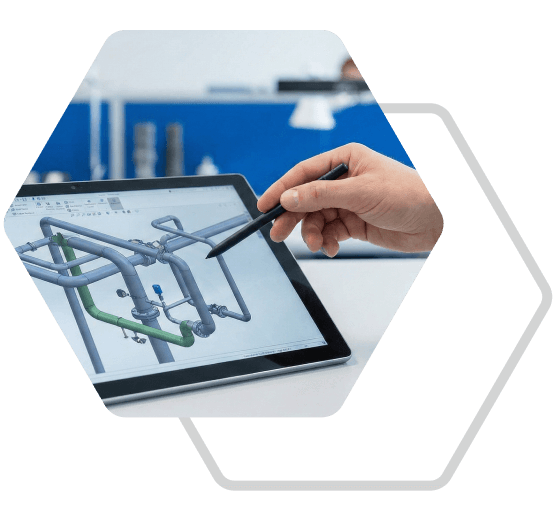
What you get in the package with the fasteners
PED-related documentation
Declaration of conformity with the PED 2014/68/EU directive.
EN 10204 inspection certificates
3.1 certificates for every production batch; 3.2 certificates issued with an independent external inspector where the hazard category requires it.
Source-material certificates
Mill certificates confirming the quality of the material used in production.
We deliver a complete inspection documentation package that leaves inspection in no doubt.
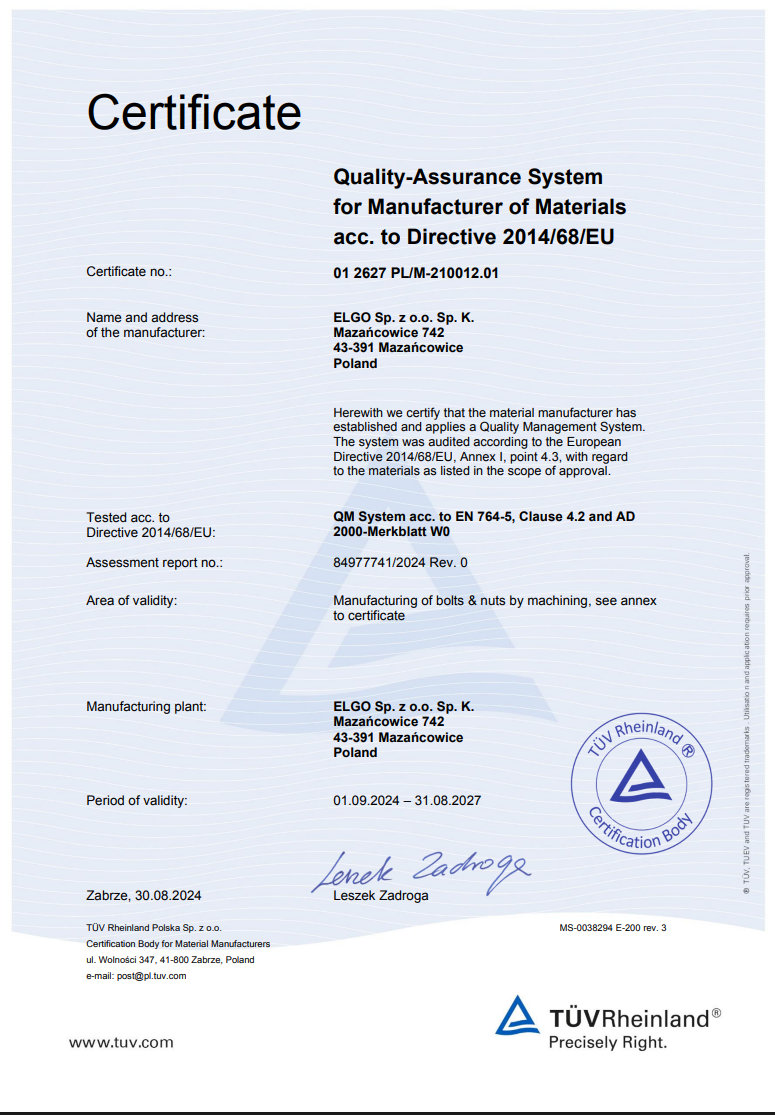
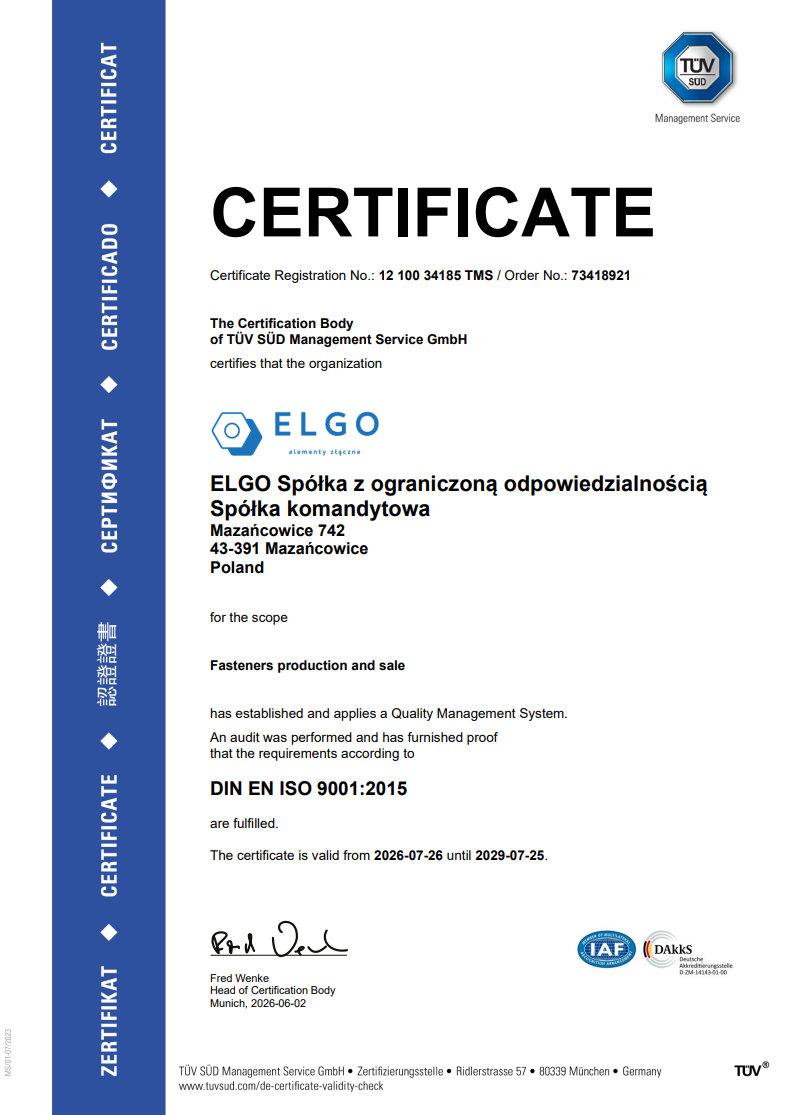
Company certificates: Elgo holds DIN EN ISO 9001:2015 (quality management system) and manufactures in compliance with PED 2014/68/EU. These are our company certifications; the EN 10204 3.1 / 3.2 documents above are per-batch material certificates supplied with the goods.
Who we work for
Elgo is a strong partner for engineering and construction firms. We specialise in serving demanding industrial investments, where there is no room for material errors.
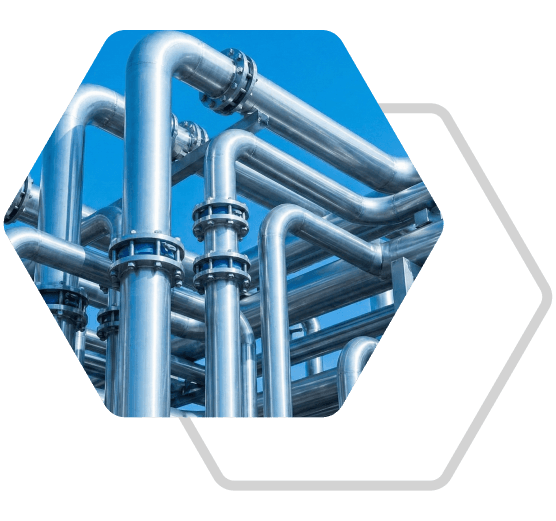
We support general contractors and engineering firms in these sectors
Oil & gas / petrochemical
Petrochemical stud bolts and flange bolting for gas stations, pipelines and compressor stations.
Chemical industry
Aggressive-media vessels, process lines.
Power
Transmission infrastructure - anchoring of power masts and towers, boilers and equipment support structures.
Our fasteners are trusted on demanding industrial projects where technical acceptance leaves no margin for error.
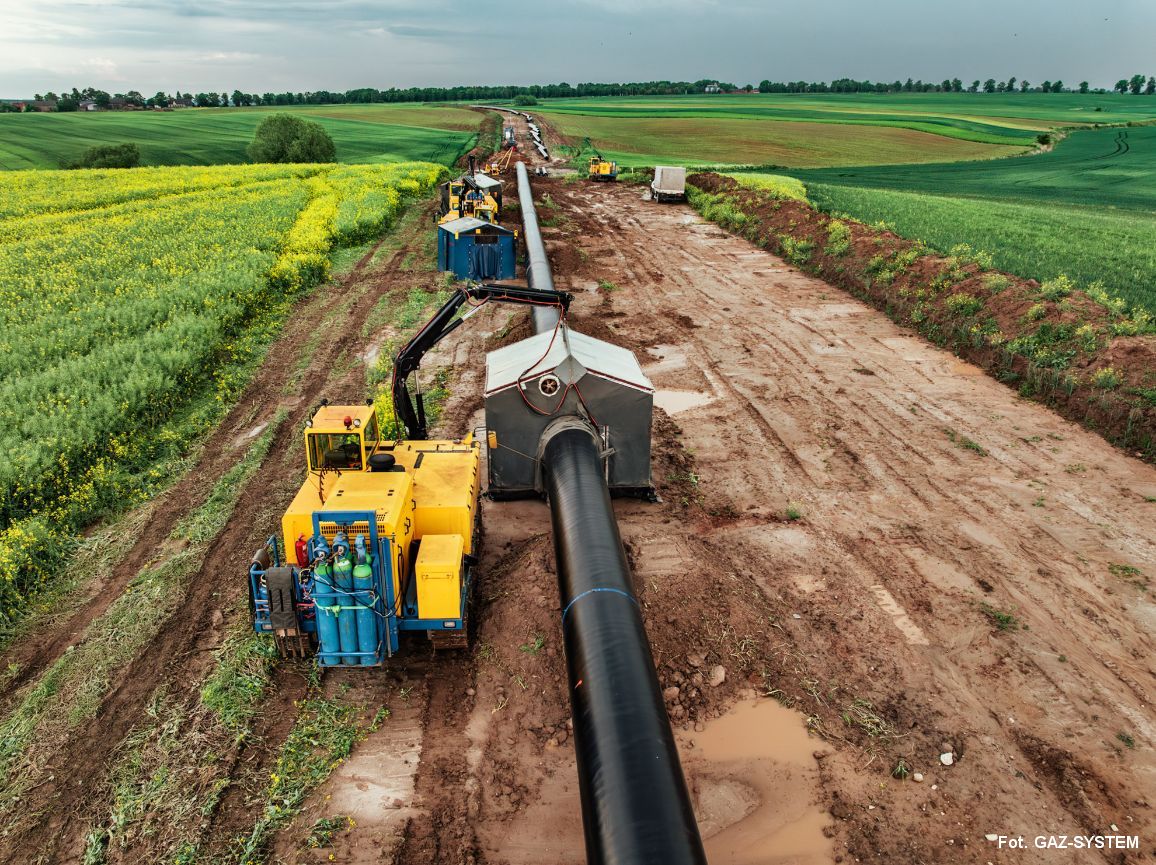
High-pressure gas transmission pipeline (Poland)
Construction of a high-pressure gas pipeline. We supplied certified transition and connection components for the gas trunk line. As part of Poland's high-pressure gas transmission network, the POM1 and POM2 pipelines (Gardeja-Kolnik-Gdańsk) represent strategic assets for broader European energy integration and diversification.
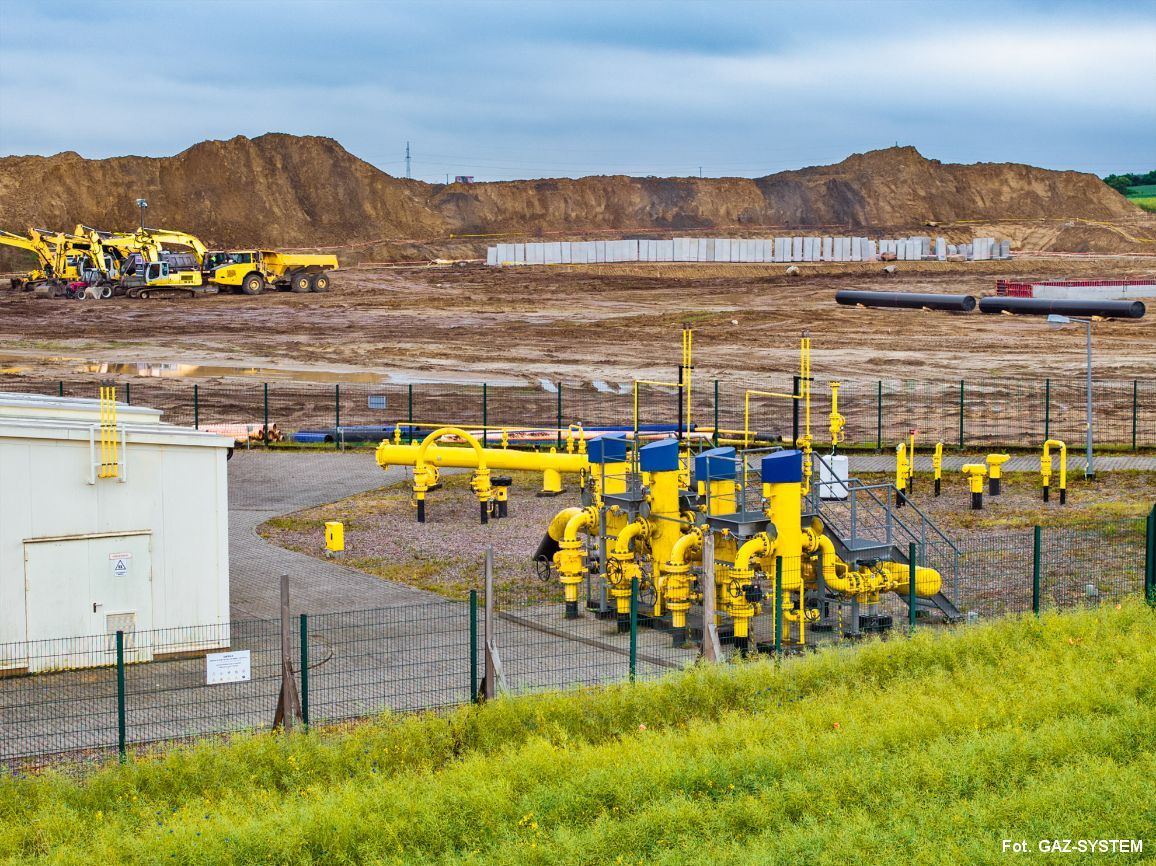
Gas metering & reduction station (Poland)
Construction of a gas station with a throughput of 250,000 Nm³/h. We supplied specialist connection components for a strategic transmission node.
Have a pressure-equipment project?
Don't let fasteners become the cause of delays. Send us your requirements and we'll verify them against PED.
Frequently asked questions
Which fasteners in a pressure system are subject to technical inspection?
Which materials are used in carbon-steel systems, and which in austenitic ones?
Can non-standard fasteners be made for inspection acceptance?
Can the manufacturer help verify material selection?
Is hot-dip galvanizing safe in pressure equipment?
Must fasteners in pressure equipment be PED-compliant?
What is the difference between a 3.1 and a 3.2 material certificate?
Should the manufacturer take part in verifying material selection?
Elgo expert advice
When designing non-standard fasteners for pressure apparatus - special studs or fitted bolts, for example - a precise drawing is only half the job. The biggest challenge for the contractor is proving to the inspector exactly which melt the part came from. Without that, the installation will not pass acceptance under the PED directive.
At Elgo, non-standard production is our everyday work. When we make parts by machining, we rigorously maintain full backward traceability. We physically transfer the markings from certified feedstock bars onto the finished drawing-based products, keeping absolute continuity of 3.1 certificates.
My advice? If you have any doubt whether a given node can be turned or milled while meeting pressure-equipment standards, simply send us the drawing for a technological review.